Convertible Term Life Insurance: How to Switch to Permanent Coverage Without a Medical Exam
Convertible Term Life Insurance Guide

Content
Here's something most term life insurance buyers don't think about when they sign the paperwork: What if you need coverage beyond your 20 or 30-year term? Worse yet, what if a cancer diagnosis, stroke, or heart condition makes you uninsurable before that term expires?
I've watched friends face exactly this situation. They bought affordable term coverage in their 30s, developed serious health problems in their 40s, and suddenly realized their policy was about to expire with no way to replace it. That's the nightmare scenario convertible term prevents.
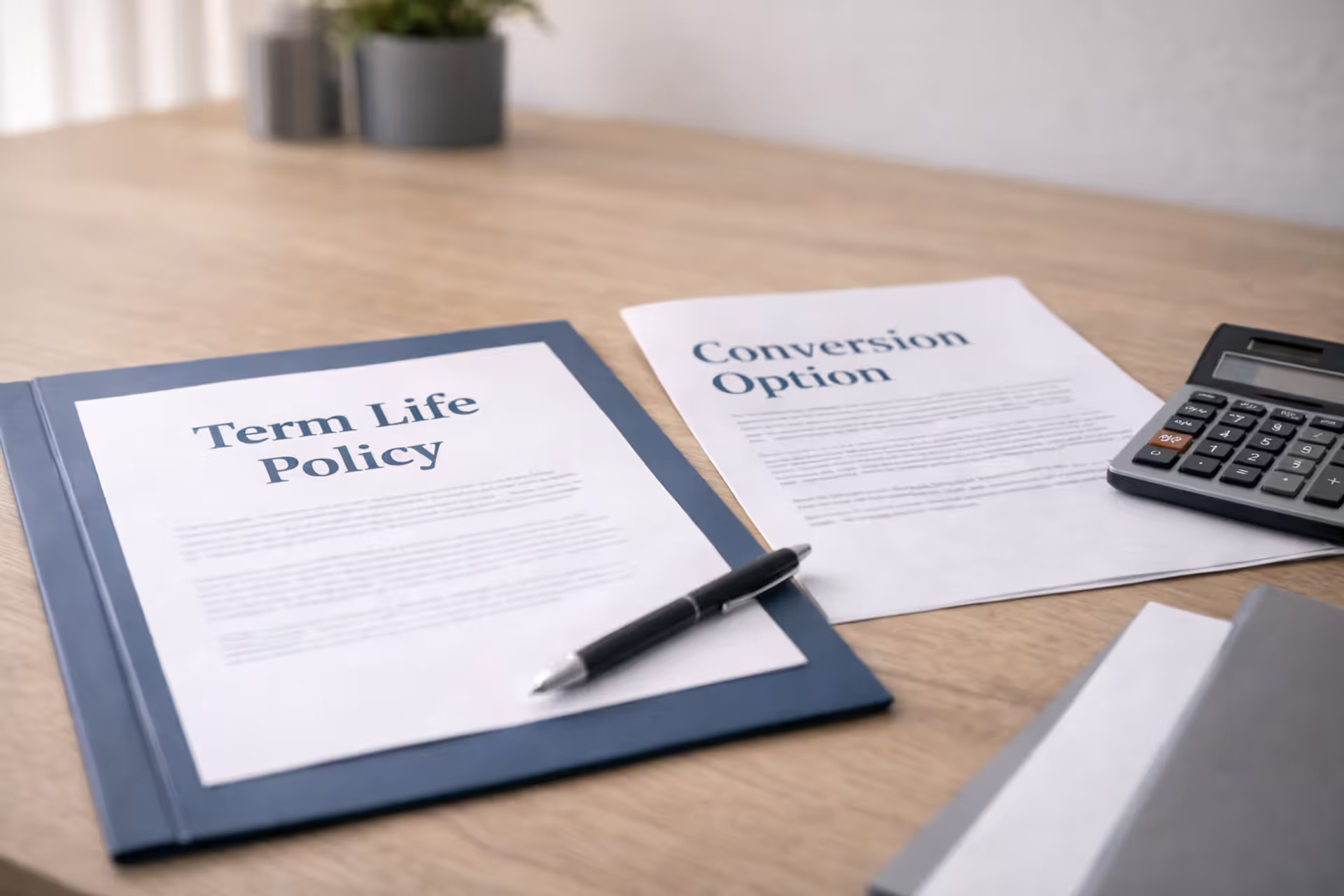
The conversion feature—often buried in policy fine print—gives you a guaranteed right to switch your temporary coverage into a permanent policy. No blood tests. No health questionnaires. No underwriting. Your insurer can't say no, even if you're fighting stage 4 cancer.
But here's the problem: carriers don't exactly advertise how this works or when your window closes. I've seen too many people discover their conversion deadline passed two years ago, right when they desperately needed it.
Let's fix that. This guide walks through every critical detail about converting your term policy—the deadlines that matter, the costs you'll face, and whether pulling that trigger makes sense for your situation.
What Makes a Term Life Insurance Policy Convertible?
Think of the conversion feature as a built-in escape hatch. Your policy includes language guaranteeing that you can exchange your term coverage for a permanent product the carrier offers. The insurance company accepts you at standard rates based purely on your age—your health since the original application is irrelevant.
Regular term policies without this provision? They just vanish when the term ends. If you need more coverage, you're starting over with a fresh application, medical exam, and underwriting decision that reflects your current health reality.
Major carriers like Northwestern Mutual, MassMutual, State Farm, and New York Life typically build the conversion privilege into their term products automatically. You're not paying extra—it's part of the standard package. Smaller carriers or policies designed for simplified issue sometimes skip this feature entirely, or they'll tack on an additional charge. Group coverage through your employer often lacks genuine conversion rights, or they'll only let you convert into limited group-based permanent products with fewer features.
The specifics vary wildly between carriers. One insurer might let you convert to any of their twelve permanent products. Another limits you to two whole life options. Some allow you to convert pieces of your coverage (maybe $200,000 of your $500,000 term). Others force an all-or-nothing decision.

Author: Michael Stanton;
Source: everymuslim.net
Pull out your actual policy paperwork—or call your agent—and verify exactly what your conversion privilege includes. Don't wait until you've received a devastating diagnosis to discover what you thought you had isn't actually there.
How the Policy Conversion Process Actually Works
The process itself? Surprisingly straightforward. You reach out to your carrier or agent saying you want to convert. They'll send documentation showing which permanent policies you qualify for and what your new premiums will be.
Pick the permanent product that fits your needs—whole life, universal life, indexed universal life, whatever they offer. Decide if you're converting everything or just a chunk of your death benefit. Sign the forms, and within 30 days you've got new permanent coverage in place.
Your premiums jump. Dramatically. A 45-year-old man paying $75 monthly for $500,000 of term coverage might see that spike to somewhere between $450 and $600 monthly for the same death benefit under a converted whole life policy. That new premium reflects what you'd pay as a 45-year-old buying coverage today (called attained-age pricing), not what you would've paid at 35 when you first bought the term policy.
But—and this is huge—your insurer can't ask a single question about your health. Diagnosed with stage 3 cancer last year? Doesn't matter. Had two heart attacks? Irrelevant. You get standard rates for your age group, period.
Your coverage continues without interruption. No gap. No new two-year contestability period. No waiting around. If something happens to you the day after your conversion completes, your beneficiaries receive the full death benefit under that new permanent policy.
Term conversion rules also dictate whether you're stuck with whatever products the carrier currently sells or if you can access older policy designs that might've been more generous. Some insurers let you convert into "legacy" products if you act within specific timeframes—sometimes these discontinued policies offered better guarantees or lower internal costs than what's available today.
Conversion Deadlines and Eligibility Windows You Can't Miss
Every single convertible term policy has a hard conversion deadline. Miss that date, and your conversion privilege evaporates completely. The most common structures include:
Time-based windows: You can convert anytime in the first 10, 15, or 20 years of your term period, or possibly up until five years before it ends. So a 30-year term might let you convert through year 25, then the option disappears even though you've got five years of term coverage remaining.
Age-based cutoffs: Your policy might allow conversion until you hit age 65 or 70, regardless of how much time remains on your term. If you purchased a 30-year term at age 45, an age-70 cap means you've got 25 years to make your decision, not the full 30.
Combined restrictions: Many carriers use both types of limits. You can convert during your first 20 years OR until you reach age 65, whichever deadline arrives first.
Once your window closes, it's permanent. Game over. If you still want permanent coverage after that point, you're applying for a brand-new policy with full medical underwriting. If your health has declined—and statistically, it probably has—you'll either pay significantly higher rates or get declined outright.
The carrier-to-carrier differences are massive. Banner Life allows conversion through your entire term period on many of their policies. Protective Life typically caps conversions at year 20 or age 70. Pacific Life offers extended windows on certain product lines. You can't assume anything—check your specific policy language.
Partial conversion gives you middle-ground flexibility. Let's say you're holding a $1 million term policy, but you really only need $300,000 in permanent coverage for final expenses and estate planning. You can convert that $300,000 to whole life while keeping $700,000 as term coverage. This approach dramatically reduces your premium increase while still locking in guaranteed lifetime protection for your most critical needs.

Author: Michael Stanton;
Source: everymuslim.net
Early Conversion vs. End-of-Term Conversion
Converting early—say, at year five of a 30-year term—means you're paying permanent policy premiums at a younger age, which is significantly cheaper. But you're also committing to those higher payments for 25 extra years. Converting at age 35 instead of waiting until 55 might save you $3,000 annually on the permanent policy premiums, but you're paying those premiums two decades sooner.
End-of-term conversion extracts maximum value from your cheap term rates but results in much steeper permanent policy costs. That 60-year-old converting in year 25 of their 30-year term will face premiums triple what they would've paid converting at age 50, even though they enjoyed lower term rates for those extra 10 years.
When should you pull the trigger? If you've developed a serious health condition making you uninsurable, convert immediately. Every month you wait, you're older and the permanent policy costs more. If you're healthy but anticipate future insurability problems—maybe your father died of a heart attack at 52 and you're 48, or you work in a high-risk profession—converting earlier locks in better rates while you still have time.
What You'll Pay: Cost Differences Between Term and Converted Policies
The premium shock catches everyone off guard. Permanent coverage typically costs five to ten times what you're paying for term insurance with an identical death benefit. But you're not comparing equivalent products—permanent policies last your entire lifetime and accumulate cash value you can access, while term coverage expires worthless 99 times out of 100.
| Policy Type | Age 35 (Monthly Premium) | Age 45 (Monthly Premium) | Death Benefit | Cash Value | Flexibility |
| 20-Year Term | $35 | $75 | $500,000 | None | Policy ends after 20 years |
| Converted Whole Life | $385 | $520 | $500,000 | Yes—grows at guaranteed rate | Fixed premiums for life; can borrow against cash value |
| Converted Universal Life | $310 | $425 | $500,000 | Yes—rate varies by market | Premiums and death benefit both adjustable |
These numbers represent healthy, non-smoking males. Women typically pay 10-20% less for identical coverage. The converted policy premiums shown reflect attained-age pricing at the time of conversion, not the age when you originally bought the term policy.
Attained-age pricing is how conversions work at virtually every carrier. You're paying the rate that corresponds to your current age when you convert. This is exactly why converting at 35 costs dramatically less than converting at 55, even if both people originally bought their term policies at age 30.
Original-age pricing exists but it's uncommon. A handful of carriers offer it as a limited-time incentive. You might be able to convert within your first five years using your original purchase age for rate calculations, meaning a 35-year-old who bought a term policy at 30 could convert using 30-year-old rates. This saves thousands annually but demands quick action while that window remains open.
The value equation completely flips if your health has deteriorated. Imagine you're 50 years old. Since buying your term policy, you've been diagnosed with Type 2 diabetes and high blood pressure. If you applied fresh for permanent coverage today, you'd get rated as substandard risk—adding anywhere from 50% to 200% to standard premiums, or you might face outright denial.
Through conversion, you're paying standard rates determined solely by age. If standard permanent coverage at age 50 runs $400 monthly, but your health issues would bump you to $700 monthly (or higher), conversion saves you $3,600 every year. Over 20 years, that's $72,000 in savings—not even accounting for the very real possibility of being declined completely and losing access to coverage.
Administrative fees for conversion are minimal. Most carriers charge a small processing fee, maybe $50 to $100, but that's it. Agents typically don't earn commissions on conversions, which keeps your costs down. Watch out for surrender charges if you end up canceling a converted universal life policy within the first 10-15 years, though—those can be substantial and eat into any cash value you've accumulated.

Author: Michael Stanton;
Source: everymuslim.net
When Converting Makes Financial Sense (And When It Doesn't)
Conversion becomes a smart financial move when you need continued coverage and your insurability has taken a hit. Three scenarios where it clearly makes sense:
Health deterioration: You've been diagnosed with cancer, experienced a heart attack, developed diabetes, or received any other diagnosis that would trigger declined coverage or significantly higher premiums. Converting locks in coverage you couldn't get anywhere else. A 48-year-old with a recent cancer diagnosis who converts their $750,000 term policy secures lifetime protection their family desperately needs—protection no other insurer would ever approve.
Estate planning triggers: Your net worth has grown beyond the federal estate tax exemption ($13.61 million per individual in 2024, though that number is scheduled to drop to roughly $7 million in 2026). Permanent life insurance creates instant liquidity for paying estate taxes without forcing your heirs to sell assets at fire-sale prices. Converting existing term coverage often costs less than applying fresh for a large permanent policy in your 60s, particularly if your health isn't perfect.
Cash value accumulation goals: You're looking for a tax-advantaged savings vehicle with guaranteed growth characteristics. Whole life cash value grows tax-deferred, and you can access it through policy loans without triggering taxable events. For high-income earners who've already maxed out 401(k)s, IRAs, and other retirement accounts, converted whole life policies offer an additional tax-sheltered accumulation vehicle.

Author: Michael Stanton;
Source: everymuslim.net
Conversion doesn't make sense in these situations:
You're still healthy and qualify for competitive rates: A 50-year-old in excellent health should absolutely shop for new permanent coverage rather than automatically converting. A fresh policy might offer better product features, lower premiums through competitive shopping, or more favorable policy terms than the limited options your current carrier makes available through conversion.
You don't actually need lifetime coverage: If your life insurance need is temporary—covering a mortgage that'll be paid off in 10 years, replacing income until your kids graduate college—just let the term policy expire naturally and pocket the savings. Permanent coverage costs far more than the statistical probability of death during any given policy year.
You can't realistically afford the long-term premiums: Permanent policies require decades of premium payments. If there's substantial risk you'll need to cancel the policy in 10-15 years because you can't afford it, you'll lose the coverage and surrender most of your cash value to penalties. You're better off maintaining affordable term coverage for as long as possible.
Sarah Thompson, a CFP® and principal at Thompson Wealth Advisors, puts it this way:
The conversion decision ultimately comes down to insurability. If you've experienced a major health event—heart attack, stroke, cancer diagnosis—conversion is almost always your best move because you're locking in standard rates that would be completely unavailable if you applied fresh. But if you're still healthy, you owe yourself the due diligence of getting quotes on new policies. The conversion option is valuable insurance, but it shouldn't be your automatic default.
— Sarah Thompson
Beyond straight conversion, consider alternatives like shopping for a new policy if you're healthy, purchasing a smaller permanent policy to supplement continued term coverage, or exploring hybrid products like guaranteed universal life that deliver permanent protection at lower premiums than traditional whole life.
5 Mistakes People Make When Converting Their Term Policy
Procrastinating until the deadline is breathing down your neck: Conversion paperwork takes time to process. If you wait until you're in month 239 of a 240-month conversion window, you're risking missing the deadline entirely due to processing delays, misplaced paperwork, or simple administrative errors. Start conversations with your insurer at least six months before your deadline hits.
Failing to compare different permanent product types: Most carriers offer multiple permanent products you can convert into—whole life, universal life, indexed universal life, variable universal life. Each product has different cost structures, cash value growth potential, and flexibility features. Whole life delivers guarantees but demands higher premiums. Universal life offers flexibility but carries more risk. Don't just accept whatever product the customer service rep mentions first—demand illustrations for all available products and compare them carefully.
Overlooking cash value growth projections: Permanent policies build cash value, but growth rates vary enormously between product types. Whole life guarantees modest growth plus potential non-guaranteed dividends. Universal life growth depends on whatever interest rates the carrier credits, which fluctuate with market conditions. Variable products tie your cash value directly to market performance. Review the illustrated projections carefully and understand both guaranteed values and non-guaranteed scenarios before committing.
Neglecting to update beneficiary designations: Conversion creates a brand-new policy with fresh paperwork. Your beneficiary designations don't automatically carry over from your old term policy. If you converted five years ago but never updated beneficiaries after getting divorced and remarried, your ex-spouse might still be the designated beneficiary on that new permanent policy. Review and explicitly confirm beneficiaries as part of every conversion.
Converting the wrong amount of coverage: Just because you currently hold $1 million in term coverage doesn't automatically mean you need $1 million in permanent coverage. Take a hard look at your actual lifetime needs—final expenses, potential estate taxes, legacy goals for children or charities—and convert only what's genuinely necessary. A 55-year-old whose mortgage is paid off and whose kids are independent might only need $250,000 in permanent coverage, not the full $1 million. Converting less dramatically reduces your premium burden while still securing the coverage you actually need.
Frequently Asked Questions About Term Life Conversion
Making Your Conversion Decision
The conversion feature embedded in your term policy represents a valuable financial option—one that becomes absolutely priceless if your health takes a turn for the worse. But like any option, it comes with an expiration date and specific terms that determine whether it's worth exercising.
Start by confirming your exact conversion deadline and which permanent products you can access. Contact your insurer or agent directly and request detailed conversion illustrations showing premiums for each available permanent policy type. If you're still in good health, get quotes for new permanent coverage from multiple carriers so you can compare what's available through conversion against what you might secure on the open market.
Think carefully about your actual lifetime coverage needs, not just your current death benefit. Your 30-year-old self might have purchased $1 million to replace income and cover a large mortgage, but your 55-year-old self might only genuinely need $300,000 for final expenses and leaving a legacy. Right-sizing your permanent coverage keeps premiums manageable over the long haul.
If your health has changed significantly since purchasing your term policy—diabetes diagnosis, heart disease, cancer treatment, autoimmune disorders, or even substantial weight gain and elevated blood pressure—conversion almost certainly offers better value than shopping for new coverage. The guarantee of standard rates regardless of current health status represents the core benefit of the conversion privilege.
Set a calendar reminder for one year before your conversion deadline arrives. That gives you plenty of time to request detailed illustrations, compare different options, consult with a financial advisor or insurance professional who specializes in this area, and complete all paperwork without last-minute pressure and stress. The absolute worst mistake you can make with conversion is letting the deadline slip past simply because you kept meaning to look into it but never quite got around to it.
Your convertible term life insurance includes a built-in safety net. Whether you ultimately use that safety net depends on your health situation, your financial needs, and your timing—but knowing exactly how the conversion feature works ensures you can make that decision strategically and thoughtfully rather than desperately scrambling at the last minute.