
Short Term Life Insurance: When Temporary Coverage Makes Sense
Short Term Life Insurance Explained

Content
Walk into any insurance agent's office and mention you're shopping for life insurance. Nine times out of ten, they'll pull out quotes for 10-year, 20-year, or 30-year term policies. That's what most people buy, so that's what most agents sell.
But here's a scenario nobody talks about: You've accepted a new job starting in three months. Your current employer's life insurance ends next Friday. Your new company has a 60-day waiting period before benefits kick in. You've got roughly five months with zero coverage.
Or this: Your divorce attorney just handed you a settlement requiring you to maintain $300,000 in life insurance naming your ex as beneficiary—but only until your daughter turns 18 in seven months. Why would you lock yourself into a decade-long policy?
These situations call for short term life insurance. The coverage lasts anywhere from one month to a year (occasionally up to two years). You're not signing up for decades of premium payments. You're buying protection for a specific window when you know you're vulnerable.
Sarah Mitchell has spent 18 years as both a CFP and licensed insurance broker. She's blunt about these policies:
The tricky part? Figuring out whether you genuinely need bridge coverage or you're just procrastinating on getting proper long-term insurance. Plenty of people spend money on temporary policies they don't need. Others skip them right when they actually matter.
What Qualifies as Short Term Life Insurance
Here's the thing about "short term" life insurance: there's no official industry definition. Different carriers use the term differently. Most of the time, though, agents and companies apply this label to policies lasting less than two years.
Too many of my clients assume they'll be fine during a three or four-month gap. They think nothing will happen in such a short window. Then I remind them about Dave, a 34-year-old who died in a car accident six weeks after leaving his job and two weeks before his new insurance started. His wife got nothing. That three-month gap cost his family everything. Look, these policies aren't cheap relative to standard term insurance, and they have limitations. But I'd rather see someone overpay for three months of protection than leave their family exposed because they were 'almost' covered.
— Sarah Mitchell
Policy Duration Ranges and Limitations
You'll find temporary coverage broken into three general timeframes:
Ultra-short coverage (30-90 days): These are tough to find. Only specialized carriers bother with them, and usually only when you're converting existing group coverage or dealing with estate settlement timing issues. Death benefits typically max out between $50,000 and $100,000. The monthly cost seems cheap until you calculate what you'd pay for a full year at that rate—it's surprisingly expensive.
Standard temporary coverage (3-12 months): This is where most bridge insurance lives. More carriers write these policies. Death benefits can reach $250,000 to $500,000 (though not always). Monthly premiums feel more reasonable when you're spreading costs across six to twelve months. These work well when you're switching jobs, dealing with divorce requirements, or waiting out a medical condition before applying for permanent coverage.
Extended temporary policies (1-2 years): Some companies offer what they call "short term" policies lasting up to 24 months. At this duration, you're really getting close to traditional term insurance territory—just with different underwriting rules and possibly different conversion options. These make sense for longer business transitions or temporary spousal support obligations.
Here's what catches people off guard: most temporary coverage doesn't renew. Your six-month policy expires, and you're done. Want more coverage after that? You're starting over with a fresh application, new underwriting, potentially higher premiums (especially if your health changed), and the risk of getting denied.

Author: Christopher Baldwin;
Source: everymuslim.net
How It Differs From Traditional Term Life
Standard term life insurance comes in clean, predictable packages. Ten years. Fifteen years. Twenty years. You know your premium on day one, and it stays locked for the entire period.
Short term policies don't work this way. When they do offer renewal (which isn't common), your monthly premium can jump based on your age or health status. You won't get rate guarantees extending years into the future. The per-month cost almost always runs higher than if you took a 10-year term policy and divided it by 120 months.
Underwriting differs substantially. Traditional term policies involve comprehensive medical exams, prescription database checks, detailed health questionnaires, and sometimes attending physician statements because carriers are committing to cover you for a decade or more. Temporary policies often use simplified underwriting—basic health questions, no blood work, no physical exam—since the carrier's risk exposure lasts months instead of years.
Coverage amounts tell a similar story. You can get $1 million, $2 million, even $5 million with standard term life. Many short term policies cap out at $250,000 to $500,000. Carriers don't want massive exposure for brief periods without thorough medical underwriting to protect themselves.
Common Situations That Call for Temporary Coverage
Bridge insurance makes sense when you can point to a calendar and identify exactly when your coverage need expires.

Author: Christopher Baldwin;
Source: everymuslim.net
Job transitions: You've signed an offer letter. Start date is 90 days out. Your current employer's group life insurance terminates on your last day—four weeks from now. Your new employer provides coverage, but there's a 60-day waiting period after you start. You're looking at roughly three months uninsured. Temporary coverage costing $40-80 monthly (depending on age, health, and coverage amount) bridges this specific gap until your new group benefits activate.
Mortgage protection during home sale: Your current house has a $400,000 mortgage. You're buying a smaller place with a $200,000 mortgage, closing in about four months. You carry a $500,000 term policy now but plan to reduce it to $300,000 after the new house closes. A temporary policy covering the $200,000 difference protects you during those four months, then you cancel it and adjust your permanent coverage downward.
Divorce settlement requirements: The judge ordered you to maintain $300,000 in life insurance with your ex-spouse as beneficiary until your youngest child reaches 18—which happens in eight months. You're not committing to a 10-year policy for an eight-month legal obligation. Temporary coverage satisfies the court order without overpaying.
Waiting for permanent policy approval: You applied for a $1 million whole life policy six weeks ago. Underwriting is taking 8-12 weeks because you had thyroid surgery two years ago and they need additional medical records. Right now you have zero coverage. A six-month temporary policy protects you during this approval process, and you cancel it once the larger policy issues.
Business partnership transitions: Your business partner is buying your 50% ownership stake over the next six months in three installments. During this transition, you need $200,000 covering the partnership agreement. After the final buyout payment, this specific coverage becomes unnecessary. Bridge insurance covers those six months without locking you into years of unnecessary premiums.
Estate planning delays: Your estate attorney is restructuring your trust and changing beneficiary designations—a process taking 4-6 months due to the complexity. During this transition period, you need additional coverage ensuring estate taxes get paid if you die before restructuring completes. Temporary coverage plugs this specific planning gap.
Notice the pattern? Each scenario has a definable endpoint. That's the key differentiator. When you can't identify when the coverage need ends, temporary insurance is probably the wrong tool.
Types of Bridge Insurance Options Available
"Short term life insurance" isn't one single product. Several coverage types can serve as temporary protection, each with different trade-offs.
Author: Christopher Baldwin;
Source: everymuslim.net
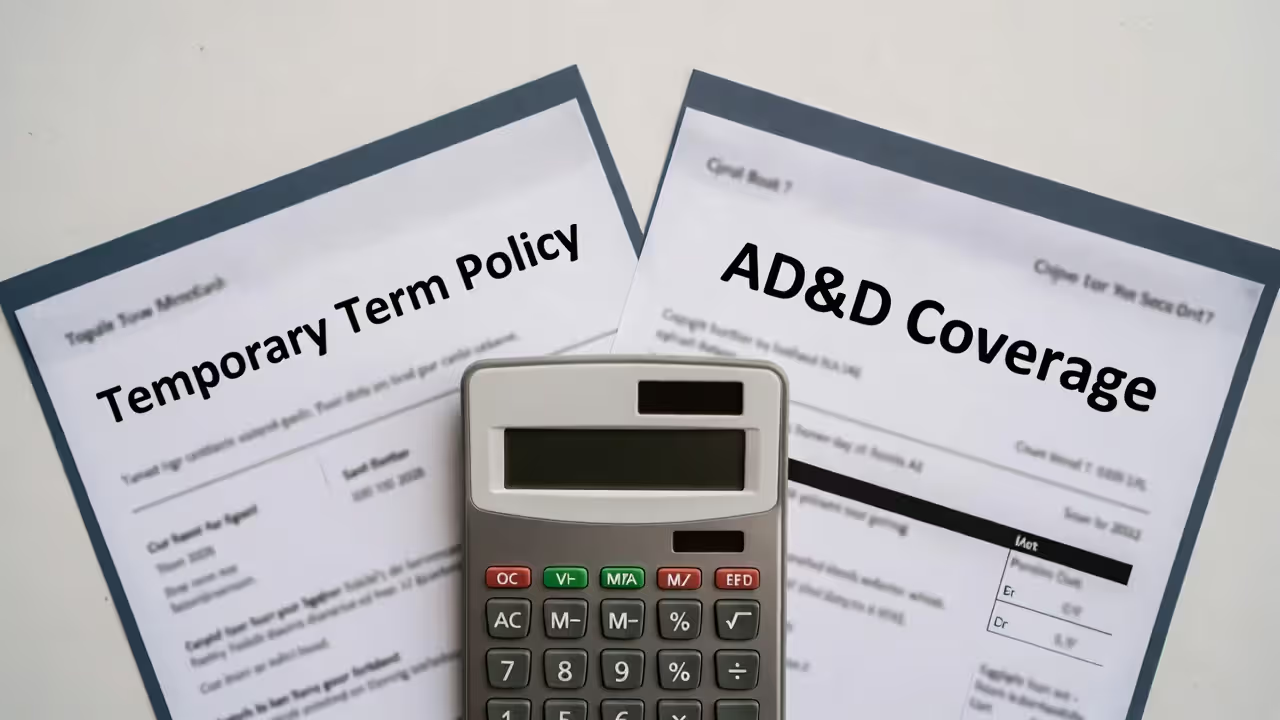
Temporary Term Policies
These resemble traditional term insurance the most—just with shorter durations. You apply through a carrier or broker, answer health questions (and maybe do a medical exam), then receive a policy with a specific death benefit for a defined period.
Advantages: Real life insurance coverage paying death benefits to your chosen beneficiaries. Coverage amounts reaching $500,000 with certain carriers. Premiums stay consistent throughout the policy duration.
Disadvantages: Not every carrier writes these products, so shopping around gets complicated. Underwriting can consume 2-4 weeks, which doesn't help when you need immediate coverage. Monthly premiums run higher than standard term policies when you calculate proportional costs.
Best for: Situations requiring substantial coverage ($100,000 or more) for 3-12 months where you can afford to wait a few weeks for approval.
Accidental Death Coverage as a Stopgap
Accidental death and dismemberment (AD&D) policies only pay benefits if you die from an accident—not illness, disease, or natural causes. They're not technically life insurance, but they're incredibly easy to obtain and can provide some protection during very brief gaps.
Advantages: Zero medical underwriting required. Approval happens almost instantly. Premiums run very low—often $15-30 monthly for $250,000 coverage. Available through many employers, credit unions, and membership organizations.
Disadvantages: Covers only accidental death, representing roughly 6% of all U.S. deaths. Doesn't protect against heart attacks, cancer, strokes, diabetes complications, or other common death causes. Numerous exclusions apply (intentional self-harm, drug overdoses, certain high-risk activities).
Best for: Very short gaps (30-60 days) when you need something immediately and can't wait for underwriting, understanding you're accepting significant limitations.
Employer-Sponsored Conversion Rights
Most group life insurance policies through employers include conversion privileges. When you leave your job, you can convert your group coverage to an individual policy—typically within 30-60 days of employment termination. The carrier accepts you without additional underwriting.
Advantages: Approval is guaranteed regardless of current health status. The carrier can't require additional medical exams or questionnaires. Coverage begins immediately upon conversion. You can usually convert to permanent insurance (whole life or universal life) lasting your entire lifetime.
Disadvantages: Converted policies almost always become whole life insurance with substantially higher premiums than term insurance. Death benefit amounts typically can't exceed what you had through your employer (often $50,000-$100,000). The conversion window is short—miss the deadline and this option disappears permanently.
Best for: People with serious health conditions who likely can't qualify for traditional coverage, or those needing immediate protection while evaluating better long-term options.
Cost Factors: What You'll Actually Pay
Premiums for short term life insurance don't follow the same pricing patterns as traditional policies. Several factors create cost variations that surprise first-time buyers.
Age and health status: A healthy 30-year-old might pay $25-40 monthly for $100,000 in six-month coverage. That same coverage could cost a 50-year-old $70-120 monthly. Add health issues like controlled diabetes or high blood pressure, and expect premiums jumping 25-50% or outright coverage denials.
Coverage duration: Here's a counterintuitive pricing quirk: very short policies (30-60 days) often carry higher per-month costs than 6-12 month policies. Carriers have administrative costs and risk assessment expenses regardless of policy length. Spreading these fixed costs over just one or two months makes each month expensive.
Medical exam requirements: Policies with simplified underwriting (no exam, just health questions) charge 15-30% higher premiums than medically-underwritten policies. You're paying for convenience and speed. Complete an exam and you'll save money if you can wait for results.
Application and administrative fees: Some carriers tack on $50-150 in upfront fees for temporary policies. These fees feel proportionally higher than what you'd pay for a 20-year term policy because carriers face similar administrative costs but collect premiums for far fewer months.
Comparison to annual term rates: Break down a standard 10-year term policy into monthly costs and you'll discover it's cheaper than short term coverage. A healthy 35-year-old might pay $20 monthly ($240 annually) for a $250,000 10-year term policy. That same person might pay $60-80 monthly for $250,000 of six-month temporary coverage. You're paying a premium for flexibility and the abbreviated commitment period.
The math rarely favors temporary coverage from a pure cost perspective. You choose it for flexibility and the defined endpoint, not to save money.
How to Apply Without Getting Denied
Temporary coverage has simpler underwriting than traditional policies, but you can still face denial or delays if you make common mistakes.
Don't skip health disclosure questions: Even simplified underwriting asks about recent diagnoses, medications, and medical treatments. Applicants sometimes think "it's just temporary coverage" and rush through details. If you die during the coverage period and the carrier discovers you didn't disclose health issues, they can deny the claim. Answer every question completely and honestly.
Have recent medical records ready: Seen a doctor in the past 12 months for anything beyond routine checkups? Gather those records before applying. Carriers may request them, and having them ready accelerates approval. Delays usually happen because applicants scramble to obtain documentation after the carrier requests it.
Apply before your current coverage ends: Don't wait until your last day of employer coverage to start a bridge policy application. Begin the process 4-6 weeks before your gap starts. If underwriting takes longer than expected or you get denied, you'll have time finding alternatives.
Be realistic about coverage amounts: Applying for $500,000 in temporary coverage when you've never carried life insurance before raises red flags. Carriers wonder why you suddenly need massive coverage for such a short period. Match your coverage amount to your actual temporary need. Bridging a three-month gap before new employer coverage starts? Request an amount similar to what your new group policy will provide.
Understand the effective date: Many policies don't start immediately. Even with simplified underwriting, you might face a 2-3 day waiting period. Need coverage starting on a specific date (like the day your current policy terminates)? Plan accordingly and confirm the effective date before finalizing the application.
Know the payment structure: Some temporary policies require full payment upfront (all six months paid at once). Others allow monthly payments. Planning to cancel the policy early once other coverage activates? Understand the refund policy. Not all carriers provide prorated refunds for unused months.
Common denial reasons: Recent cancer diagnosis or treatment (within 2-5 years), uncontrolled diabetes with recent complications, heart attack or stroke within the past year, current pregnancy complications, or dangerous occupations (commercial fishing, logging, roofing). If any apply to you, consider AD&D coverage or employer conversion rights instead.
Approval timelines range from 48 hours (simplified underwriting, no exam) to 3-4 weeks (full underwriting with medical exam and records review). Plan according to when your coverage gap begins.
Comparing Short Term vs. Standard Term Life Insurance

Author: Christopher Baldwin;
Source: everymuslim.net
A side-by-side comparison clarifies when each option makes sense.
| Feature | Short Term Life Insurance | Standard Term Life Insurance |
| Policy duration | 1-12 months (occasionally up to 24 months) | 10, 15, 20, 25, or 30 years |
| Monthly premium (example: 35-year-old, $250K coverage) | $60-100/month | $20-30/month |
| Medical exam requirements | Frequently waived with simplified underwriting | Typically required for coverage exceeding $100K |
| Renewal/conversion options | Limited or nonexistent; usually must reapply | Often includes conversion to permanent insurance |
| Maximum coverage amounts | Usually $250K-$500K | $500K to $5 million or higher |
| Approval timeframe | 2-7 days (simplified) to 2-4 weeks (full underwriting) | 3-6 weeks on average |
| Cancellation flexibility | Cancel anytime; refund policies vary by carrier | Cancel anytime; no refunds for unused portion |
| Best use cases | Job transitions, waiting periods, defined short-term needs | Long-term income replacement, mortgage protection, estate planning |
The table makes the value proposition clear: you're paying more per month for short term coverage, but you're not locked into years of premiums for protection you only need temporarily.
When Temporary Coverage Is a Mistake
Bridge insurance isn't appropriate for every situation. Several scenarios call for traditional term or permanent coverage instead.
When you can't identify an endpoint: Thinking "I'll get temporary coverage and figure out something permanent later"? You're setting yourself up for problems. Once your six-month policy expires, then what? If you still need coverage (and most people do), you'll pay for underwriting again, potentially face higher premiums if your health changed, or risk a coverage gap if you forget to reapply. Get appropriate long-term coverage from the start.
When you're using it to delay a decision: Some people buy short term policies because they're overwhelmed by life insurance options and want to postpone the decision. This costs more in the long run. Those temporary policy premiums are money you'll never recover, and you'll still face the same decision in a few months—except you'll be older and potentially less healthy.
When your "temporary" need is actually ongoing: Young children? A mortgage? Anyone financially dependent on your income? Your need isn't temporary—it's long-term. A parent thinking "I'll just get six months of coverage while I research my options" is misunderstanding their actual protection need. Your kids will depend on you for the next 15-20 years, not six months.
When the cost difference is negligible: If a 10-year term policy costs $25 monthly and temporary six-month coverage costs $70 monthly, the math doesn't work. Even thinking you only need six months of coverage, you're better off buying the 10-year policy and canceling after six months. You'll pay $150 for six months of protection versus $420, and you'll have the option keeping it if circumstances change.
When you're trying to avoid underwriting: Buying simplified-issue temporary coverage specifically to dodge medical exams because you have health problems? You're likely paying significantly higher premiums than necessary. Many people with well-managed health conditions (controlled high blood pressure, diabetes with good A1C levels, past cancer with several years of clean follow-ups) can qualify for standard term insurance at reasonable rates. The medical exam might reveal your health is better than you think.
When you need coverage for business succession or estate taxes: These obligations don't vanish in 6-12 months. Business succession planning and estate tax liabilities require permanent solutions. Temporary coverage creates a dangerous gap where your business partners or heirs could be left unprotected.
The rule of thumb: if there's any chance you'll still need life insurance when your temporary policy expires, buy appropriate long-term coverage now. The peace of mind and cost savings outweigh the flexibility of short-term policies.
Frequently Asked Questions About Interim Coverage
Short term life insurance serves one specific purpose: protecting your family during defined transitional periods when you know you'll need coverage for months rather than years. It's not a replacement for comprehensive protection, and it's definitely not a cost-effective long-term solution.
The decision boils down to three questions: Can you identify exactly when this coverage need ends? Does the premium cost make sense for the specific protection period? Do you have a concrete plan for coverage after this temporary policy expires?
Answer yes to all three? Temporary coverage might be appropriate. Uncertain about any of these questions? Traditional term insurance—even if you plan canceling it after a short period—is likely the better choice.
Most people need life insurance for years or decades, not months. But for those specific situations where bridge insurance fills a genuine gap, having temporary protection beats leaving your family unprotected while you wait for long-term coverage to begin.