
Renewable Term Life Insurance: How Policy Extensions Work and What They Cost
Renewable Term Life Insurance

Content
That term life policy you bought years ago? It's about to expire. You've got three options, and most people don't realize they already own the best one.
Option one: let it end and go without coverage. Option two: fill out applications with new insurance companies, submit to medical exams, and hope they approve you at rates you can afford. Option three: use the renewal feature already written into your contract.
Most people discover this third option by accident. Buried in your policy documents sits a clause giving you the right to extend coverage past the original end date—without proving you're still healthy.
Why this matters: imagine you bought a policy at 35 when you were running marathons. Fast forward to 50 and you're managing diabetes, taking blood pressure medication, and your doctor's mentioned the word "cholesterol" more times than you can count. Try applying for new coverage now and you'll either face rejection letters or premium quotes that make your eyes water. Your renewable policy? It simply continues. You'll pay more because you're older, but the insurance company can't ask about your health changes or turn you down.
The cost increase can sting. Renewal isn't charity—insurance companies price this guarantee into your original contract, which explains why policies with renewal rights cost slightly more upfront than cheaper alternatives that dead-end at expiration.
Most carriers include renewal features automatically these days, but the specifics vary wildly. Some policies let you renew yearly. Others offer a fresh 10-year term. These differences matter enormously when you're staring down an expiration notice, which makes understanding them now—not later—essential.
What Makes Term Life Insurance Renewable?
Guaranteed renewability boils down to one ironclad commitment: the insurance company cannot refuse your extension request, period. Your renewal gets approved regardless of what's happened since you signed the original application.
Diagnosed with cancer? Took up skydiving? Changed careers from office work to deep-sea welding? The insurer doesn't get to ask and can't deny coverage based on any of it.
Your policy declarations page outlines the specific rules. Look for the maximum age for renewals (70 is common, though some stretch to 95), the method they'll use to calculate your new premium, and confirmation that your death benefit stays the same. Read this section carefully before you buy—not when you're three weeks from expiration and panicking about what happens next.

Author: Michael Stanton;
Source: everymuslim.net
Compare this with non-renewable term coverage. Those policies cost less initially because the insurer's responsibility ends completely when the term expires. Buy a 20-year non-renewable contract at 35? When you turn 55, that policy vanishes. Want to continue coverage? You're starting from scratch with a brand-new application, complete medical workups, and premiums reflecting both your current age and health status.
Here's the subtle benefit renewal offers versus applying fresh: your original health classification carries forward. Qualified for their best "preferred plus" pricing initially? That classification determines your renewal costs. A new application puts everything under scrutiny again—your weight, cholesterol numbers, family medical history, hobbies—potentially pushing you into a more expensive risk category even if you're reasonably healthy.
Some policies bury renewability inside an optional rider instead of including it automatically. Certain employer group plans and bare-bones budget products strip out renewal rights to cut costs aggressively. Before signing anything, verify that extension privileges actually exist in your specific contract language.
How Annual Renewable Term Policies Differ from Standard Term Insurance
Annual renewable term (ART) coverage resets every 12 months instead of locking rates for 10, 20, or 30 years like conventional level term products. Each year, you're essentially buying a fresh one-year policy priced at your now-older age. Maximum flexibility? Yes. Steadily climbing costs? Also yes.
Traditional level term spreads risk across decades. That 20-year contract averages what insuring you will cost from ages 35 through 55. You overpay the true actuarial expense during younger years and underpay it later. The insurer bets that enough customers will drop coverage early to offset those who stick around long-term. ART products eliminate this averaging—you pay exactly what insuring someone your precise age costs right now.
This creates predictable escalation: ART premiums roughly double every 8-10 years as mortality risk climbs. A 35-year-old paying $400 annually might face $800 at 45 and $1,600 at 55 for the same death benefit. Level term sidesteps these jumps by fixing your rate throughout the initial period.

Author: Michael Stanton;
Source: everymuslim.net
When ART Policies Make Financial Sense
Need coverage for just 2-5 years? ART excels in these situations. Maybe you're paying down a specific loan balance or bridging an income gap with a definite closing date. Committing to a 10-year level term contract would mean spending more total money than necessary with year-by-year renewables.
Bridge scenarios work particularly well. Perhaps your business partnership buyout closes in three years, or your pension vests at 48. ART provides family protection during that transition without locking you into long-term premiums for coverage you won't need.
Tight budgets sometimes make ART your only realistic option. A young family requiring $750,000 in protection but juggling daycare costs and student loans can start with annual renewable coverage, then shift to level term when income improves. Immediate protection materializes without premium payments that wreck your monthly budget.
Industries and Situations Where ART Coverage Is Common
Corporate America runs heavily on ART mechanics for employer group life insurance. The year-by-year structure accommodates employee turnover while letting HR teams adjust benefits annually. You probably won't even recognize it as ART—premiums vanish from your paycheck automatically, often with employer subsidies masking the cost increases.
Mortgage protection leans heavily on annual renewable structures when homeowners want coverage that decreases alongside their loan balance. The flexible death benefit adjustments align perfectly with ART's design—you can modify coverage each year without replacing the entire contract.
High-net-worth individuals sometimes deploy ART for estate liquidity while waiting for trusts to mature or asset repositioning to complete. They need coverage spanning 3-7 years maximum, making the short-term nature and flexibility worth higher per-year costs versus permanent insurance.
Understanding Renewal Premiums: Why Costs Increase Each Year
Mortality tables drive renewal premium calculations—statistical models predicting how likely someone your age is to die within the next 12 months. These actuarial tables reveal an uncomfortable reality: death probability roughly doubles every eight years. A healthy 40-year-old faces approximately 0.15% annual mortality risk, while that same person at 50 confronts 0.35%—more than double.
Age-based pricing flows from this mathematics, not arbitrary corporate greed. When you renew at 46 instead of 45, the insurer genuinely confronts elevated risk of paying your death benefit that year. Premiums must climb proportionally or the company's risk pool collapses.
Gender plays a substantial role in these calculations. Women outlive men by 5-7 years statistically, producing 15-30% lower premiums at identical ages and health classifications. Here's how gender affects annual renewable pricing:
Annual Premium Examples for $500,000 Death Benefit (Preferred Non-Smoker Health Class)
| Age | Male Annual Cost | Female Annual Cost |
| 35 | $375 | $295 |
| 40 | $485 | $380 |
| 45 | $710 | $545 |
| 50 | $1,165 | $885 |
| 55 | $1,940 | $1,450 |
Sample rates based on typical preferred-class pricing from major carriers as of 2024
A 55-year-old man pays over five times what a 35-year-old man pays for the same coverage. This isn't corporate price-gouging—it's mathematical reality reflecting mortality risk. The exponential curve embedded in ART structures becomes impossible to ignore as birthdays accumulate.
Administrative overhead and profit margins also factor into renewal premiums, but these represent small percentages versus underlying mortality expenses. Market competition keeps these charges fairly consistent between companies, making age-based risk the overwhelming driver of what you'll ultimately pay.
Certain contracts cap renewal premiums—either through percentage limits on annual increases or absolute dollar ceilings. These protections guard against rate shock but typically mean higher initial premiums since the insurer shoulders extra risk. Your policy's fine print reveals whether these safeguards apply to your specific situation.

Author: Michael Stanton;
Source: everymuslim.net
The Policy Extension Process: What Happens at Renewal
Your insurer typically launches automatic renewal 30-60 days before your policy anniversary. Expect paperwork showing your updated premium and payment deadline. Keep paying without responding and coverage rolls seamlessly into the next period without interruption.
Certain policies demand manual confirmation instead. You'll receive forms requesting active confirmation that you want extended coverage, due back 15-30 days pre-expiration. Miss that deadline and you've created a coverage gap that might demand full underwriting to repair.
Here's the beauty of renewal documentation: typically there isn't any. Guaranteed renewability eliminates medical exams, health questionnaires, and financial underwriting. You pay the updated premium and you're finished. Death benefit stays identical, beneficiaries remain unchanged—only the cost increases.
Payment method matters more at renewal than during your initial term. Establish automatic bank drafts or credit card payments to dodge missed payments that could terminate your coverage. Configure autopay at least 60 days before renewal so the new premium processes smoothly when the rate increase arrives.
People accidentally create coverage gaps by misunderstanding their contract's renewal mechanics. You might assume renewal happens automatically when your policy actually demands manual confirmation. Then you discover coverage lapsed only when attempting to file a claim. Pull out your policy documents six months before expiration and determine exactly what your renewal process requires.
Many carriers now provide online portals for simplified renewal—you confirm continuation and update payment details electronically. These systems blast out reminder emails and texts, drastically cutting accidental lapses. Ask your agent whether digital renewal exists for your contract.
State regulations force insurers to mail written renewal notifications at least 30 days pre-expiration in most jurisdictions. These consumer protections ensure fair warning about premium changes and deadlines, but acting on that information remains your responsibility alone.
Renewal vs. Conversion: Choosing Your Coverage Path
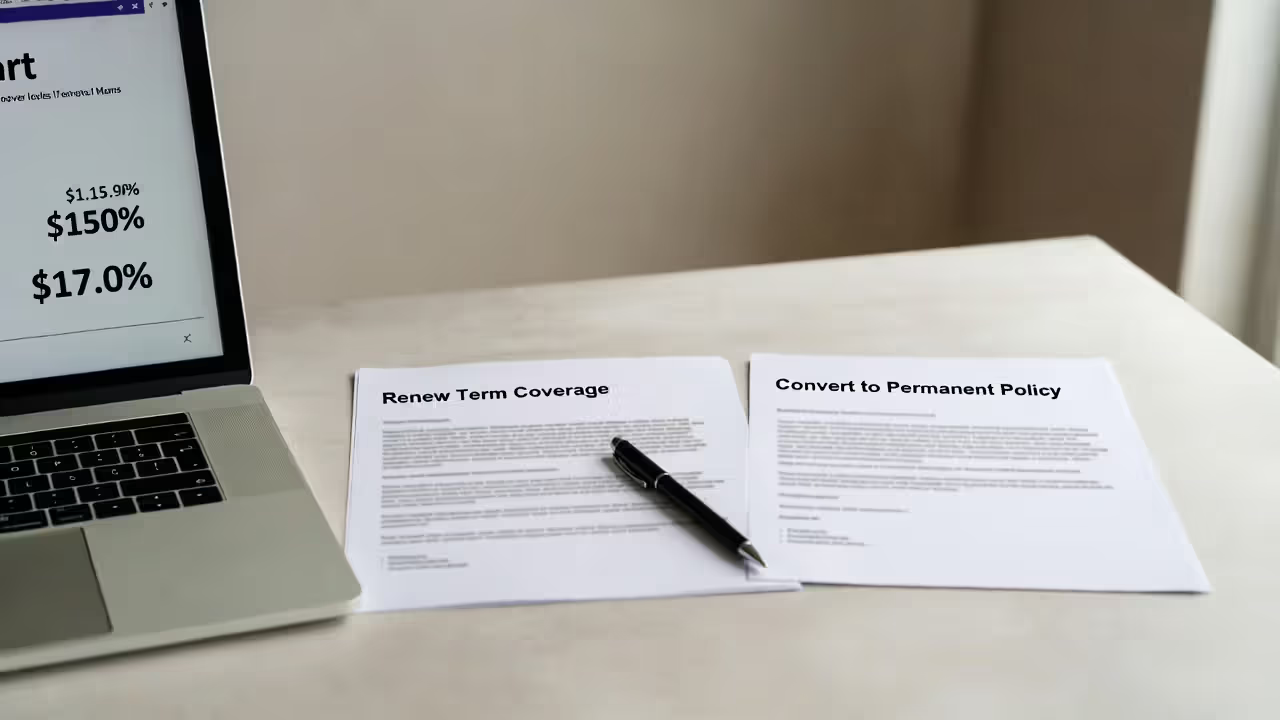
Renewal means extending your term insurance structure while accepting escalating premiums each period. Conversion flips your term contract into permanent life insurance (whole life or universal life) without medical underwriting, locking in level premiums and building cash value.
Most renewable term contracts bundle conversion privileges with firm deadlines—typically before age 65 or within the first 10-20 policy years. These deadlines carry enormous consequences because conversion rights vanish permanently once the window closes. You forfeit guaranteed access to permanent coverage forever.
Cost comparisons between renewal and conversion reveal messy tradeoffs. Renewing your term coverage at 50 might run $1,200 annually with continued increases looming. Converting to whole life could demand $8,500 yearly for equivalent death benefits. The permanent policy costs substantially more now but never increases, eventually becoming less expensive than perpetually renewed term coverage.
Patricia Hernandez, a CFP with 23 years specializing in insurance planning, explains:
Most people delay thinking about conversion until it's too late. The math typically favors switching between ages 50-60 if you need lifetime coverage. Wait until 65 and you've paid peak term renewal rates for years while your conversion window expired. My advice? Review this decision every three years after you hit 45.
— Patricia Hernandez
Run a break-even analysis to identify your optimal path. Calculate total premiums you'd pay through age 85 or 90 under both scenarios—continuing term renewals versus converting to permanent insurance today. The crossover point where permanent insurance becomes more economical often lands 15-20 years post-conversion, making it advantageous for lifetime coverage requirements.
Your health status weighs heavily in this decision. Developed conditions that would make new permanent insurance prohibitively expensive or impossible to obtain? Conversion becomes incredibly valuable. That guaranteed conversion right delivers permanent coverage at standard health rates regardless of what your medical records reveal now.
Permanent policies accumulate cash value—a living benefit completely absent from term insurance. Yes, this feature increases costs substantially, but it creates emergency funds, retirement income supplements, or long-term care financing that pure death benefit coverage cannot provide.
Author: Michael Stanton;
Source: everymuslim.net
Common Mistakes When Renewing Term Life Coverage
Accidentally letting policies lapse wins the dubious honor of most frequent renewal mistake. You receive that renewal notice showing a dramatic premium jump, think "I should compare alternatives," then miss the payment deadline while procrastinating. Coverage terminates, often precisely when health changes make obtaining new insurance difficult or impossible.
Ignoring conversion deadlines destroys your guaranteed access to permanent coverage. Too many people assume they can convert whenever they want, discovering too late that their contract limited conversion to before age 60 or within the first 15 policy years. Once that window closes, you're passing full medical underwriting to get permanent insurance—assuming you can get approved at all.
Failing to shop around before renewing means potentially overpaying for coverage substantially. Life insurance pricing shifts constantly based on market competition and underwriting standards. If your health remains solid, applying for fresh coverage might deliver better rates than renewing your existing contract, even accounting for your increased age.
Not reassessing your coverage requirements leads to paying for unnecessary death benefits. That $500,000 you needed to cover your mortgage at 35 might be excessive at 55 when the loan's mostly paid off and your kids are financially independent. Dropping to $200,000 at renewal slashes premiums substantially while still providing appropriate protection.
Assuming renewal premiums continue forever causes planning disasters. Most renewable term policies terminate at age 70, 80, or 95 regardless of renewal provisions. Need lifetime coverage? Waiting until the renewal option expires forces you into expensive guaranteed-issue permanent policies or leaves you completely uninsured.
Overlooking payment method updates creates administrative nightmares. That bank account you established for automatic payments 15 years ago might be closed now, causing renewal premium payments to bounce. Verify your payment information 60 days before renewal to prevent these easily avoided coverage gaps.
Frequently Asked Questions About Renewable Term Life Insurance
Wrapping Up: Making Renewal Rights Work for You
Renewable term life insurance delivers critical flexibility when your coverage requirements stretch beyond initial term periods or health changes slam the door on obtaining new insurance. Those guaranteed extension rights protect you from becoming uninsurable while maintaining death benefit coverage for dependents and financial obligations.
Understanding ART policy mechanics versus standard level term contracts helps you pick appropriate coverage structures from the start. ART policies deliver lower initial costs for short-term requirements but generate exponentially increasing premiums over time. Level term with renewal options balances predictable costs during the initial period against extension flexibility afterward.
Those renewal premium increases stem from mathematical mortality risk, not arbitrary carrier decisions. Age-based pricing reflects actuarial reality—insuring someone at 55 genuinely costs substantially more than covering a 35-year-old because death probability has doubled. These increases make long-term renewable term coverage expensive versus permanent insurance alternatives.
The extension process demands attention to specific deadlines and documentation requirements spelled out in your contract. Automatic renewal provisions simplify continuation but don't eliminate your responsibility to verify coverage remains in force and premiums process correctly. Set calendar reminders 90 days before renewal dates to prevent costly administrative mistakes.
Evaluating renewal versus conversion options every few years after 45 positions you to make strategic decisions about permanent coverage while conversion rights remain available. That guaranteed conversion privilege provides valuable access to whole life or universal life insurance without medical underwriting, often making financial sense for lifetime coverage requirements.
Avoiding common renewal mistakes—especially missing conversion deadlines and failing to reassess coverage amounts—saves thousands in unnecessary premiums while ensuring appropriate protection continues. The renewable feature costs money through higher premiums, so deploy it strategically rather than defaulting to automatic renewal without periodic evaluation.