Return of Premium Life Insurance: How ROP Policies Work and What They Cost
Return of Premium Life Insurance

Content
Here's an unusual insurance pitch: pay premiums for decades, and if you never file a claim, the company gives back every penny. That's the core promise behind return of premium life insurance—survive your policy term, and you'll receive a refund check for all the premiums you paid.
Sounds great, right? There's a catch. These policies charge substantially higher premiums than regular term coverage—sometimes nearly twice as much. Whether you come out ahead depends on what you'd actually do with that extra money if you weren't paying it to an insurance company.
Let's break down exactly how these policies function, what they cost, and who benefits most from choosing the refund option.
How Return of Premium Term Life Insurance Works
Think of ROP coverage as regular term life insurance with a savings account attached. You pick your coverage amount and how long you want protection—most people choose 20 or 30 years. During that time, you're completely covered. If something happens to you, your family gets the full death benefit.
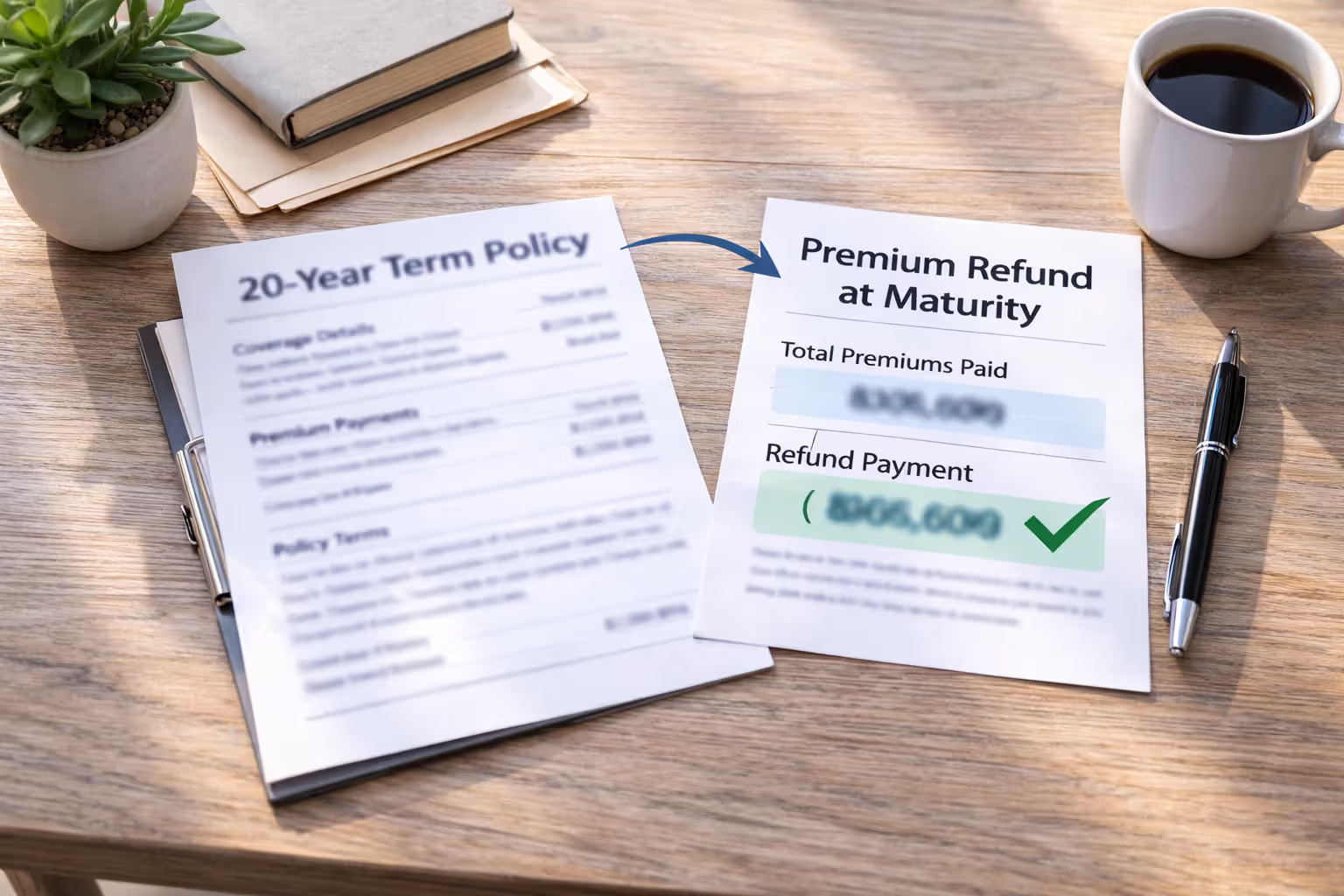
The refund component kicks in only after you reach the finish line. Make it to the end of your term with the policy still active? The insurer cuts you a check for everything you paid. Most companies send one lump sum payment, though a few let you spread it across several years.
What you get back is the raw dollar amount—nothing extra for inflation or time. If you paid $45 per month for twenty years, that's $10,800 returned. Not $10,800 plus interest. Just the base amount.
Different endings produce different outcomes. Die in year seven of a 20-year policy? Your beneficiaries collect the death benefit, but nobody sees a premium refund. The money-back guarantee requires you to outlive the full term. Cancel early—say, year 12 of that same 20-year policy? Most companies keep everything, though some return a fraction based on how long you held coverage. Switch to permanent insurance midway through? That conversion usually voids your refund rights since you're terminating the original agreement.
Here's what separates ROP from whole life or universal policies: these term policies don't accumulate cash you can access. No loans against future refunds. No partial withdrawals. The payout is binary—survive the term and collect, or don't and lose it.
Author: Danielle Harper;
Source: everymuslim.net
ROP Rider vs. Standard Term Life: Cost Comparison
The price gap between standard term and ROP coverage is dramatic. Insurance companies calculate what they'll owe you in two or three decades, figure out the present value of that future payment, then divide it across all your premium installments. That's on top of the usual mortality charges and company expenses.
Take a 35-year-old man in good health shopping for $500,000 of 20-year coverage. Regular term? Maybe $30 monthly. Add the refund feature? That same policy jumps to $55-65 per month. Women pay less overall because they statistically live longer, but the ROP markup stays proportionally similar—roughly 80-100% more than basic term.
Comparing Costs: Standard Term vs. ROP Over 20 Years

Author: Danielle Harper;
Source: everymuslim.net
| Death Benefit | Standard Monthly Cost | ROP Monthly Cost | Extra Paid Over 20 Years | Amount Refunded | Your Final Cost |
| $250,000 | $18 | $33 | $3,600 | $7,920 | $0 |
| $500,000 | $30 | $58 | $6,720 | $13,920 | $0 |
| $1,000,000 | $50 | $98 | $11,520 | $23,520 | $0 |
Rates shown for a 35-year-old male, non-smoker, excellent health rating. Your actual quotes will vary by company and health status.
Here's the math question nobody wants to hear: what if you bought cheap term and invested that monthly difference? Put that $28 in a basic index fund every month. If it grows at just 3.8% annually, you'd match the ROP refund after twenty years. Factor in taxes on investment profits, and you need maybe 4.2% returns to break even.
Financial advisors typically consider 4% a reasonable conservative estimate for long-term balanced portfolios. By that logic, you'd likely end up with more money investing the difference yourself. But that's only true if you actually invest it consistently—something most people don't do.
Conditions That Determine Whether You'll Get Your Premium Refund
Every carrier writes slightly different rules about when and how you qualify for your refund. These details matter more than you'd think, especially when you're making decisions fifteen years into a twenty-year policy.
Dropping coverage early: Walk away from your ROP policy in year four of a 20-year term? You typically get nothing back. Zero cash surrender value is standard for the first several years. Some insurers start building small surrender values around year 10—maybe returning 30-40% of what you paid if you cancel at year 15. Always ask for the surrender value table in writing before buying.
Missing payments: Skip enough premium payments that your policy lapses, and you've probably forfeited your refund permanently. You get the standard 30-day grace period, but let it lapse beyond that and you lose both protection and the money-back feature. Some companies allow reinstatement within a certain window, but you might need new medical exams, and reinstatement doesn't always restore full refund rights.
Partial refund variations: Some carriers sell "partial ROP" riders that only return premiums if you die during the term—essentially boosting your death benefit. Others offer graded schedules: survive the full 20 years and get 100% back, but die in year 18 and your beneficiaries get 90% of premiums plus the standard death benefit. These cost less than full ROP but add complexity to an already complicated product.
Using conversion privileges: Nearly all term policies let you convert to permanent coverage without new health screenings. Exercise that right, though, and you'll typically wave goodbye to your premium refund. The conversion terminates your original ROP contract. A few companies allow splitting conversions—turn half your death benefit into whole life while keeping ROP active on the other half—but that's uncommon.
One detail people miss: how the company defines "premiums." Some contracts only refund base premiums, excluding monthly policy fees or rider charges. If you added disability waiver coverage or an accelerated death benefit rider, those extra costs might not count toward your refund calculation.
Who Should Consider Buying a Return of Premium Policy
ROP makes sense for a specific type of person: someone who can afford higher premiums but struggles to save money independently. If your pattern is spending whatever hits your checking account, the forced discipline has real value. The insurance company becomes your accountability partner.
Consider Marcus, a 40-year-old contractor earning $135,000 yearly. He needs $750,000 coverage to protect his wife and two kids. But he's honest about his habits—extra cash disappears into his hobbies or home projects rather than savings accounts. For Marcus, paying $85 monthly for ROP versus $42 for standard term creates forced savings he wouldn't otherwise achieve. Twenty years later, that $20,400 refund represents money he admits he probably wouldn't have accumulated any other way.
Now compare that to what financially disciplined people should do. Already maxing out your 401(k)? Got a solid emergency fund? Actually invest extra money rather than spending it? Then buying cheaper term coverage and investing that $43 monthly difference almost certainly beats the ROP refund. A 35-year-old couple investing $40 monthly at 5% annual returns would accumulate $16,000-22,000 over twenty years—meaningfully more than they'd get back from an ROP policy.
The forced savings angle outweighs the mathematical disadvantage when: - You earn enough that high tax rates make after-tax investment returns less attractive - Your employer doesn't offer retirement plans with matching contributions - You've got a track record of failing to maintain separate savings - The psychological benefit of "getting insurance free" matters enough to you that lower returns feel acceptable
ROP doesn't make sense if you might cancel coverage before the term ends. Planning to downsize your death benefit once your mortgage is paid off in 10 years? Standard term gives you that flexibility without worrying about forfeiting a refund.
Common Mistakes People Make When Evaluating ROP Coverage
The biggest oversight? Forgetting that dollars lose purchasing power over time. That $20,400 refund in 2045 won't buy what $20,400 buys today. Assuming 3% annual inflation—pretty conservative—money loses roughly 45% of its value over two decades. Your "complete refund" might only cover 55% of what those premiums originally could have purchased.
Insurance agents often frame ROP as "getting your coverage for free," which is misleading. You're not getting free insurance—you're prepaying for a future refund by accepting substantially higher premiums today. Paying more now is always more expensive than paying less now and receiving the same amount later. That's not magic; it's just time value of money.
Another error: calculating returns wrong. Some buyers think "I paid $20,000 and got $20,000 back, so I broke even." But you didn't break even—you came out behind whatever you could have earned on that money elsewhere. If you paid an extra $8,000 over 20 years to receive $20,400 eventually, your internal rate of return is around 4.7%. That's not terrible, but it's nowhere near the 9-10% historical average of stock market returns.
Misreading partial refund terms causes problems too. One policyholder assumed dying in year 19 of a 20-year ROP term would trigger a prorated refund. His contract actually specified that death at any point during the term meant beneficiaries got only the death benefit—no premium return. He'd paid nearly double the standard premium for nineteen years without receiving the signature ROP benefit.
Some buyers think they can access ROP money if emergencies arise before term end. Unlike whole life policies with cash value loans, ROP products typically offer zero liquidity. You can't borrow against that future refund or make withdrawals. That inflexibility can create financial hardship if circumstances change unexpectedly.

Author: Danielle Harper;
Source: everymuslim.net
How to Decide If ROP Life Insurance Is Worth the Extra Cost
Start by getting actual quotes for both options with identical coverage amounts and term lengths. Many insurers provide instant online quotes, but working with an independent agent who represents multiple carriers often uncovers better pricing.
Real example: A 38-year-old woman, non-smoker, excellent health, wants $600,000 of 25-year coverage. Standard term quotes from five top-rated carriers range from $43-51 monthly. Those same carriers charge $82-96 monthly for ROP versions. Over 25 years, she'd pay $12,900-15,300 for regular term versus $24,600-28,800 for ROP—a difference of $11,700-13,500.
What happens if she invests that monthly difference ($39-45) in a tax-advantaged retirement account earning 6% annually? She'd accumulate roughly $24,000-27,000 after 25 years—noticeably more than the $24,600-28,800 ROP refund. But again, that assumes perfect consistency with monthly investing.
The return of premium feature appeals to loss aversion—people hate the idea of 'wasting' money on insurance they don't use. Mathematically, most clients would do better investing the premium difference themselves, but human behavior doesn't always follow mathematical optimization. For clients who genuinely won't invest that money, ROP can deliver value despite producing lower returns.
— Michael Chen
Questions worth asking your agent before you buy:
What's the surrender value at different points? Get specific numbers for years 5, 10, 15, and 20. Some policies build almost no surrender value until the final years.
How do partial conversions impact my refund? If you convert half your death benefit to permanent insurance, do you still receive half the premium refund on the remaining term portion?
Which charges count toward the refund? Some carriers exclude monthly administrative fees from what they refund.
What if I decrease my coverage mid-term? Dropping from $500,000 to $300,000 might eliminate the ROP provision completely or reduce the refund proportionally.
How strong are your financial ratings? ROP policies require the insurer to stay solvent for 20-30 years. Look up their ratings from AM Best, Moody's, and S&P.

Author: Danielle Harper;
Source: everymuslim.net
Frequently Asked Questions
Deciding whether to buy return of premium coverage requires honest self-assessment. Will you actually invest the premium difference consistently over 20 or 30 years? Do you have tax-advantaged investment accounts available? How much do you value the certainty of receiving premiums back versus accepting potentially higher but uncertain investment returns?
For disciplined savers with solid investment habits, standard term coverage almost always produces better financial results. The premium savings, invested consistently in diversified portfolios, typically outpace the nominal refund by meaningful margins.
But for people who struggle with savings discipline or place high psychological value on eliminating "wasted" insurance premiums, ROP policies serve a legitimate purpose. They enforce savings through higher premiums and guarantee a future refund that might not materialize otherwise.
Calculate what your situation produces. Get quotes from multiple carriers for both standard and ROP coverage. Figure out what you'd accumulate by investing the difference at conservative return assumptions. Then honestly assess whether you'd actually maintain that investment discipline for two or three decades.
The best life insurance is whichever coverage you'll maintain when your family needs it most. If ROP's forced savings mechanism and refund guarantee make you more likely to keep adequate coverage in force, the mathematical inefficiency might be worth accepting.